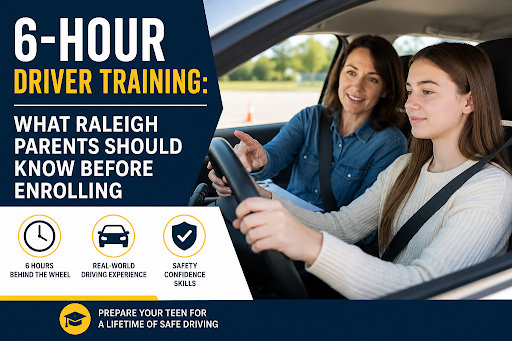
6-Hour Driver Training: What Raleigh Parents Should Know Before Enrolling
If you’re the parent of a teenager who just picked up their learner’s permit, you’ve probably already heard about the state’s behind-the-wheel requirements — and you’ve probably also heard the term “6-hour driving course” thrown around by other parents, DMV staff, or your teen’s school counselor. It’s one of the most talked-about (and misunderstood) parts of getting a new driver road-ready in North Carolina.
This guide breaks down exactly what 6-hour driver training in Raleigh, NC actually involves, why it matters, and what to look for when choosing a program for your teen.
What Is 6-Hour Driver Training in Raleigh, NC?
North Carolina’s Graduated Driver License (GDL) program is built around the idea that new drivers need supervised, gradual exposure to real driving conditions before they’re fully licensed. Classroom instruction teaches the rules of the road, but it can’t replace the experience of actually sitting behind the wheel with a trained instructor beside you.
That’s where 6-hour driver training in Raleigh, NC comes in. It’s a structured, one-on-one (or small-group) block of in-car instruction, typically split across two or three sessions, where a certified instructor guides a teen through real driving scenarios in an instructor-equipped vehicle. Unlike practicing with mom or dad in the family car, this training is led by someone trained specifically to teach new drivers how to react to traffic, judge distances, and handle unfamiliar roads calmly.
Many families in Raleigh, Cary, Apex, Garner, Fuquay, and Clayton treat this training as a checkpoint between classroom learning and the many hours of supervised practice a teen still needs to log before taking the road test.
Why Every Teen Needs a 6-Hour Driving Course in Raleigh, NC
Some parents assume that if their teen has already logged a few hours driving around the neighborhood, formal instruction isn’t necessary. In reality, a 6-hour driving course in Raleigh, NC fills gaps that casual practice simply can’t.
A few reasons this structured training matters:
● Professional feedback in real time. Instructors can immediately correct habits like late braking, poor mirror checks, or hesitant merging — habits that are hard for parents to catch and even harder to correct without sounding like nagging.
● Exposure to situations parents avoid. Many parents steer new drivers away from highways, busy intersections, or nighttime driving simply because it feels risky. A trained instructor can introduce these situations in a controlled, coached way.
● Reduced stress for the whole family. Teaching your own teenager to drive can strain even the calmest parent-child relationship. Handing some of that responsibility to a neutral, experienced instructor takes pressure off both sides.
● Better road test outcomes. Instructors know what the NCDMV examiner is looking for during the actual road test, from proper stopping distance to correct lane positioning, and they train toward that standard.
What Happens During Behind-the-Wheel Training in Raleigh, NC
Parents often want to know exactly what their teen will be doing during those six hours. While every program structures its sessions a little differently, quality behind-the-wheel training in Raleigh, NC typically covers:
● Vehicle basics and pre-drive checks — mirror and seat adjustment, understanding dashboard indicators, and basic vehicle control.
● Neighborhood and residential driving — stop signs, turns, right-of-way, and pedestrian awareness.
● Intersections and traffic signals — judging gaps in traffic, protected versus unprotected turns, and four-way stops.
● Lane changes and merging — checking mirrors and blind spots before moving between lanes.
● Highway driving — accelerating to merge safely, maintaining following distance, and exiting confidently.
● Parking maneuvers — parallel parking, three-point turns, and backing up safely, all of which are commonly tested on the road exam.
● Defensive driving fundamentals — recognizing hazards early, adjusting for weather, and reacting to other drivers’ mistakes.
Instructors also use this time to build a teen’s confidence gradually, starting with quieter streets and working up to more complex driving environments as the student demonstrates readiness.
How This Fits Into Teen Driver Education in Raleigh, NC
The 6-hour behind-the-wheel course is just one piece of a bigger picture. Complete teen driver education in Raleigh, NC generally involves several stages:
1. Classroom instruction (30 hours) — covering traffic laws, road signs, and the responsibilities that come with a license.
2. Behind-the-wheel training (6 hours) — hands-on instruction with a certified driving instructor, which is what this guide focuses on.
3. Supervised driving practice — after classroom and in-car training, North Carolina requires new drivers to log a set number of teen driving hours NC with a licensed adult in the car, including a portion completed at night, before they can move through the state’s licensing stages.
4. The road test — the final step before earning a limited or full provisional license.
Because North Carolina uses a graduated system — moving from a learner permit, to a limited provisional license, to a full provisional license — each stage depends on the one before it. Skipping or rushing the behind-the-wheel portion often shows up later as gaps in confidence during the supervised practice hours or the road test itself. Parents should check current NCDMV requirements directly, since exact hour totals and age minimums can be updated by the state.
Choosing the Right Driving School in Raleigh, NC
Not all programs are structured the same way, so it’s worth asking a few questions before enrolling. When comparing a driving school in Raleigh, NC, consider:
● Instructor credentials. Are instructors licensed and specifically trained to teach new drivers, not just experienced drivers themselves?
● Vehicle safety features. Instructor vehicles should have dual controls, so the instructor can intervene if needed.
● Scheduling flexibility. Teens are busy with school, sports, and part-time jobs — a program that offers evening or weekend sessions makes it easier to complete training without added stress.
● Class structure. Is instruction one-on-one, or does your teen share time with other students? One-on-one time often means more personalized coaching.
● Local road familiarity. A program based in the Raleigh area, with routes through Cary, Apex, Garner, Fuquay, and Clayton, ensures your teen practices on the same roads, intersections, and traffic patterns they’ll actually be driving on.
● Transparent pricing. Look for clear packages without hidden fees, and ask whether payment plans are available.
A Few Tips for Parents Before Enrolling
● Book training sessions early — spots with experienced instructors can fill up quickly, especially during school breaks.
● Talk to your teen beforehand about what to expect, so they arrive relaxed rather than anxious.
● Keep logging supervised practice hours at home alongside formal training; the two work together, not separately.
● Ask the school directly what specific skills are covered in each session so you can reinforce them during family practice drives.
● Don’t skip night driving practice — it’s required for a reason, and it’s one of the areas new drivers feel least confident in.
Final Thoughts
Six hours might not sound like much, but for a new driver, it’s often the difference between nervously gripping the wheel and confidently handling everyday traffic. Structured, professional instruction gives teens the tools to become safe, aware drivers — and gives parents some peace of mind along the way.
If you’re a Raleigh-area parent looking for a dependable, experienced team to guide your teen through this stage, Major League Driving School offers 6-hour behind-the-wheel training designed around North Carolina’s licensing requirements, with flexible scheduling for busy families across Raleigh, Cary, Apex, Garner, Fuquay, and Clayton. You can learn more about our programs or enroll by visiting our Raleigh location at 817 New Bern Ave, Suite #3, or calling (910) 978-1929.