Teen Driver Safety Stats: Why Structured Training Matters More Than Ever
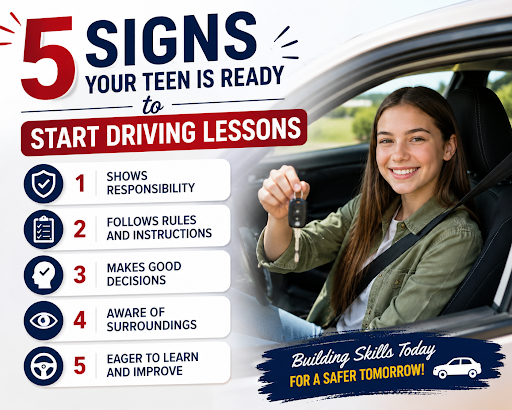
Handing your teenager the keys for the first time is a big milestone, and knowing exactly when they’re ready makes all the difference in how the experience goes. Every teenager matures at a different pace, and starting teen driving lessons in Raleigh NC too early or waiting too long can affect how confident, safe, and prepared they feel once they’re actually on the road. So how do you know the timing is right? Below are five clear signs your teen is ready to begin formal instruction, along with what you can expect once you take that next step.
Sign #1: They Show Genuine Interest in Teen Driving Lessons in Raleigh NC
One of the clearest signs a teen is ready to learn is genuine curiosity. If your teen is asking questions about how to merge onto the highway, why you brake earlier in the rain, or what a yellow light really means, that curiosity is worth paying attention to. Teens who watch how their parents handle intersections, parallel parking, or four-way stops are already absorbing the fundamentals before they ever sit behind the wheel. This kind of engagement tends to translate into better focus once formal behind the wheel training in Raleigh NC begins, because the student already wants to understand the ‘why’ behind each rule rather than just memorizing steps. If your teen brings up driving unprompted, asks to practice in an empty parking lot, or seems eager rather than anxious about the idea, that enthusiasm is a strong indicator they’re mentally ready to start.
It also helps to notice how your teen reacts when you talk about responsibility more broadly. A teen who takes ownership of small daily tasks, like keeping track of their own schedule, managing chores without reminders, or following through on commitments to friends and coaches, is usually signaling that they can handle the added responsibility of operating a vehicle. Driving is ultimately about consistently making good decisions, often without anyone watching, and a teen who already demonstrates that kind of reliability in everyday life tends to carry it over naturally once lessons begin.
Sign #2: They Can Stay Focused Without Constant Distractions
Driving requires sustained attention, and that’s a skill some teens develop earlier than others. A teen who can put their phone away during a car ride, follow a multi-step set of directions without losing track, or sit through a longer task without needing constant redirection is showing the kind of focus that driving demands. This matters because so much of what makes a new driver safe isn’t just knowing the rules, it’s noticing a pedestrian stepping off a curb, a car merging two lanes over, or a light changing color half a block ahead. Programs designed to learn to drive for teens in Raleigh NC build on this foundation by gradually increasing the complexity of driving scenarios, but that instruction is far more effective when a teen already has the attention span to take it all in. If distractions still pull your teen’s focus easily in everyday situations, it may be worth working on that before introducing the added stimulation of city traffic.
Sign #3: They Understand Basic Road Signs and Rules Before Driving Lessons for Teens in Raleigh NC
A teen doesn’t need to know everything before their first lesson, but having a basic grasp of common road signs, right-of-way rules, and speed limit meanings gives them a head start. Many teens pick this up naturally by studying for their learner’s permit test, reading the North Carolina Driver’s Handbook, or simply paying attention as passengers over the years. This baseline knowledge means less time is spent explaining what a yield sign means and more time is spent actually practicing the skill of driving itself. Solid teen driver education in Raleigh NC builds directly on this foundation, reinforcing what a teen already knows while filling in the gaps around defensive driving, hazard recognition, and decision-making under pressure. If your teen can correctly identify most common signs and explain basic right-of-way situations, they’re already ahead of where many students start.
It’s worth remembering that this knowledge doesn’t need to be perfect before lessons begin. Instructors expect to review and reinforce these fundamentals as part of the process. What matters most is that your teen has enough of a starting point to build on, rather than encountering these concepts for the very first time while actually navigating traffic.
Sign #4: They Meet North Carolina’s Age and Permit Requirements for a Teen Driving School in Raleigh NC
Readiness isn’t only about attitude and attention, it’s also about meeting the state’s legal requirements. In North Carolina, teens can apply for a limited learner permit at age 15, provided they pass the required vision and knowledge tests and, in most cases, complete a driver’s education course. From there, the state requires a minimum holding period on the learner permit before a teen can apply for a limited provisional license, along with a set number of supervised driving hours logged with a parent or guardian. Understanding these milestones ahead of time helps families plan when to start lessons so that permit requirements, practice hours, and testing all line up smoothly. A reputable driving school will walk you through each of these steps, making sure your teen isn’t just ready in spirit but also fully compliant with what North Carolina requires before they’re allowed to drive independently.
Timing lessons around these requirements also helps avoid unnecessary delays. Families who wait until the last minute to schedule instruction sometimes find themselves rushing through required hours right before a test, which isn’t ideal for building genuine confidence. Starting a bit earlier gives your teen room to practice at a comfortable pace, revisit tricky maneuvers like parallel parking or highway merging, and walk into their road test feeling prepared rather than rushed.
Sign #5: They’re Ready for Structured, Professional Instruction
Learning to drive from a parent has its place, but there’s real value in structured, professional instruction, especially for a teen’s very first lessons. A sign your teen is ready is that they can accept corrections without shutting down, follow a clear set of instructions from someone other than a parent, and stay calm when they make a mistake behind the wheel. Professional instructors are trained to give feedback in a way that builds confidence rather than anxiety, and they can spot habits, like riding the brake or checking mirrors too infrequently, that a parent might not think to correct. If your teen responds well to coaching in other areas of life, whether it’s a sport, a job, or schoolwork, that same openness to guidance usually carries over well into driver training.
Structured lessons also expose teens to a wider range of driving conditions than most parents can safely recreate on their own, from busy Raleigh intersections to highway merges and nighttime driving. A teen who’s ready for this kind of instruction generally shows patience with the learning curve, understands that mastery takes repeated practice, and doesn’t get discouraged after a rough first attempt at a new skill.
If several of these signs sound familiar, your teen is likely ready to begin the process. The right instruction at the right time builds habits that last a lifetime, not just skills to pass a test. Major League Driving School has proudly served Raleigh, Cary, Apex, Garner, Fuquay, and Clayton with a curriculum built around safety, discipline, and confidence behind the wheel. With flexible scheduling and affordable, transparent pricing, we make it easier for families to fit quality driver training into busy lives, without cutting corners on what actually keeps new drivers safe.